Monday, 8 August 2022

Why do we even care about the original cut of the “The Magnificent Ambersons”?


80 years ago, a brilliant young man named Orson Welles finished his second motion picture The Magnificent Ambersons based on the novel by Booth Tarkington, only to have it taken from his hands at the post-production stage. 


To cut a very long and convoluted story very short, the studio eventually cut about 45 minutes from the original version, rearranged and edited the scenes and audio elements, infamously filmed the additional material and tacked on something of a happy ending – basically did everything imaginable in an attempt to shape an avant-garde work of art into a standard Hollywood picture of the day, while Welles was deployed to Brazil, filming the ill-fated documentary It’s All True.

The film in its final mutilated form was eventually released in July 1942, and as it was a common practice of the day, all the cut material was subsequently destroyed, making the original version of the Magnificent Ambersons something of a cinematic Holy Grail.

It is August 2022 now.

At the moment, there are two ongoing efforts to restore the picture to its unseen Wellesian glory – the search for the answer print famously sent to Welles in Rio in March 1942 led by Josh Grossberg and his documentary team, and the Ambersons Project by Brian Rose who is independently working on restoration of the missing scenes through animation.

Whatever the outcomes of both of these efforts may be, the question remains – why are out there people who still care so much for a movie made and unmade almost a century ago?

I can think about three major reasons, the first one being our cultural obsession with ruins and the mystery that surrounds them. At this point, The Magnificent Ambersons is the Parthenon of our time, a magnificent ruin of something even more magnificent that we know once existed. We want to touch it, feel it, experience it as it was in its heyday.

Over the years, everyone who knew anything about this story tried to locate the lost scenes, or at least, tried to understand what happened in spring/summer 1942 between RKO and Welles and hopefully catch an overlooked detail that would open the case and point to the possibility of the long version somehow still surviving. There have been countless of these Ambersons searchers, more or less familiar with the Welles lore and the movie industry practices of the 1940s, over the years and it seems that there are even more of them now. Everybody wants to be a part of a story like this.

However, a miraculous find of the long cut would also mean the end of this dream, which resonates with the theme of this film and practically everything else that Orson Welles made in a very strange way, so the rhetorical question remains: do we want to find the lost movie, or are we in love with the idea of finding it?

Another reason is that we know that Orson did make another masterpiece.

The surviving cutting continuity (a textual document explaining the on-screen action) of the pre-release version and the surviving stills clearly show that Welles’ version was something way more profound and considerably more subversive, albeit in very subtle ways, than the released version ended up being, while the original score by Bernard Herrmann (also butchered by the studio) is a reminder of the carefully built structure of the movie that we have never seen.

The third reason is rather metaphysical, but possibly the most important – it is the end of our world.

Whether we are aware of this or not, the way of life that we knew and loved or hated before the pandemic hit is dead and gone and we are on the cusp of dramatic changes, not unlike the ones depicted in the Ambersons. Their world was destroyed by the horseless carriages, our world is getting destroyed by the depletion of the energy that made the horseless carriages run. Everybody is getting their comeuppance in the end and it seems that we need something as strong as the original Ambersons to remind us that nothing stays or holds or keeps where there is growth.

In 2022/2023, Joshua Grossberg will complete his documentary on the production of the Magnificent Ambersons and Welles’ work in Brazil (I have read everything released about this period and that story, essentially the one about the killing of Welles’ career in Hollywood, needs to be told).

He may even find the lost print, although I have a hunch that, if it exists at all, it will be found after his expedition. Don’t really know why, but that just sounds about right in the world of Orson Welles.

Brian Rose is close to completion of his restoration, a labour of love done independently and without the backing of the rights holders, but I imagine that it will find its way to the wider audiences once it is completed.

This means that we live in the Ambersons times and that we are, one way or another, close to experiencing the original version, 80 years after its (un)making. 

Yet, I don’t think that Welles was ahead of his time. I believe that he really understood life and knew how to convey the eternal truths, and some of those truths may be unpleasant. This is the main reason why his career was burdened by all kinds of troubles and this is the reason why we still care. 

The Magnificent Ironies

  • There was never a Director’s Cut

Although we refer to the lost 131 min. cut as the original version, there was no such thing.

As far as Welles was concerned, the film was never locked (I am doing my best to avoid the term unfinished in relation to Welles) and still required some tweaks and edits.

However, there is no doubt that it was his vision, unlike the existing 88 cut.

  • The movie, as Welles had shot it, could not have happened in 1942

Welles’ version was a complex and ultimately dark story about social and cultural changes caused by industrialization, at least on the surface. Underneath, it was an even more disturbing tale about the breakdown of communication, people and personal relationships. It was the last thing that was going to get released during the WW2, unless Welles had the final cut privilege.

While some people believe that Welles would have somehow gotten his way had he not been away in Brazil, alas, his geographic location would have made little to no difference, as he no longer had the final cut and, lest we forget, most of the studio management despised him at this point.

It was clearly stipulated in his contract with RKO that he was to complete the preview version of the movie and that afterwards he would have to edit it as directed by the studio. (As a keen reader would notice, RKO actually breached this stipulation as Welles never really completed the picture.)

In other words, it would be another Lady from Shanghai situation at best – Welles himself would need to butcher the movie, which takes us to the ultimate irony – if the answer print sent to Rio is somehow found in the viewable shape, we would have the privilege of seeing an Orson Welles production of The Magnificent Ambersons precisely because the studio destroyed it and precisely because Welles was not in Hollywood at the time.  

Rather Wellesian, isn’t it?


Sunday, 17 February 2013

How I Met W.A.Mozart


With the Return of Saturn assessing my life these days, I take a look at some of my best friends and staunchest allies who have been around for the greater part of the past 28 years I've been roaming the Planet Earth. This is the story of how I met Wolfgang Amadeus Mozart and learned to use my ears as shortcuts to Heaven.

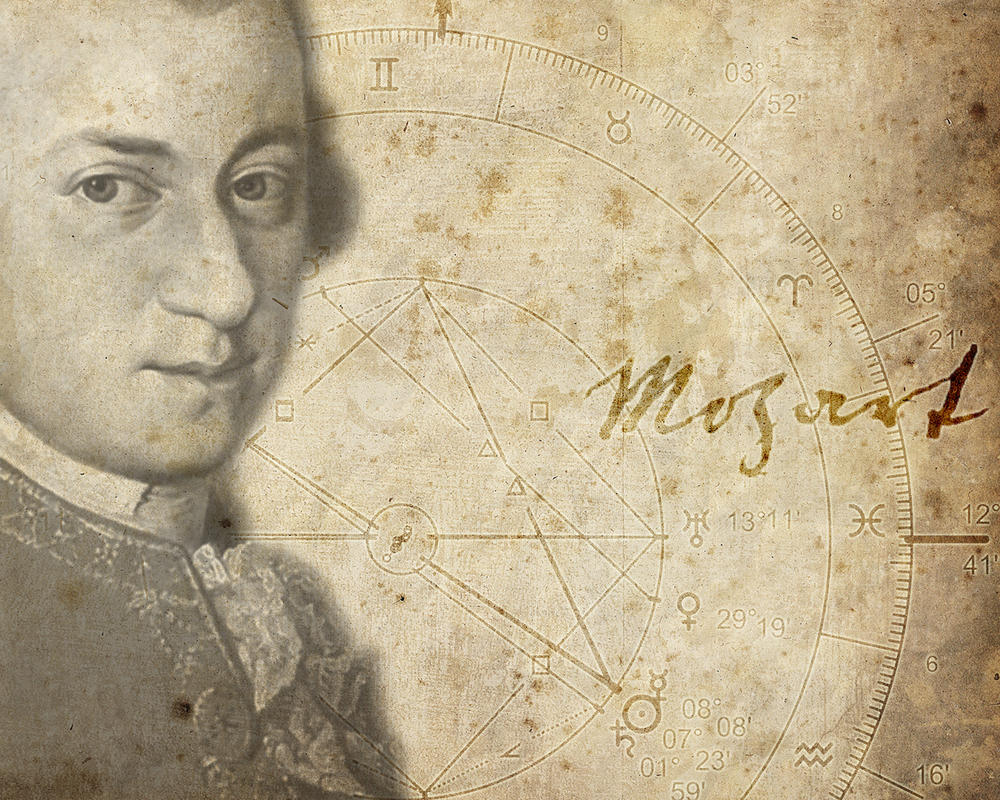
Mozart, Natal Chart and Signature - my 2009 collage

Serbia of the 1990s was not really the best place to grow up in, but it wasn't the worst either. Once the war in the neighbouring lands was over and shortages of oil, coffee, sugar and flour ended, it was almost bearable. In hindsight, those days now seem rather adventurous, I even tend to think of the 1990s as a prestigious school of life - it surely taught anyone with the eyes for the metaphysical that nothing lasts forever, that there's nothing really to be sure of in terms of social structures and values and that nothing is really impossible, on a more positive note as well as on the other one.

I grew up in Kruševac, a cosy town in Central Serbia, never too big to become unbearable and never too small to become suffocating, just one of those small centres of small administrative units that never really grow up  and never lose nor gain anything to their charm, provided that they have any. The town quietly savoured its share of the Yugoslavian moral, ethical, cultural, financial and any other downfall you may think of, and there was me, one of the boys with hope that there has to be something better in this world, albeit without any clear idea what better was or should be. Under such circumstances, meeting Mozart was the last thing one might expect to happen, but it did - truly anything was possible back in those days. 

It was just another dull day in my école primaire, a solid, tremendously depressing building, with Spartan classrooms freshly painted in three generous shades of grey. I believe I was 12 or 13, and it was a usually hopeless class of musical culture held by a lovely lady who tried so hard to share her love for music with the kids who couldn't care less for anything older than themselves and who were heavily swayed by the then-popular muzak and successfully pretended the teacher was not there at all.

I remember the day clearly because it was one of the rare occasions that I actually learned anything valuable in school. The teacher was talking about Mozart's last days with great fervour (although with more knowledge of the legend than the actual facts, as my further studies of Mozart would later show) and the tale of the mysterious disguised figure commissioning a funeral mass, Mozart's early death and the poor funeral deeply disturbed me, so I paid a closer attention to her words.

"And now, I will play you the Requiem!" - she said so solemnly that it was clear that she didn't give a damn that nobody was actually listening to her. That's the kind of attitude I'd learn to appreciate in the years to come, but that's another story.

The music began, cracking from the tape of awful quality, but it didn't matter. It didn't matter that the rest of the classroom shouted and laughed their asses off so the music was barely audible. Nothing really stopped the opening bars of Mozart's Requiem taking me to the places I never knew existed and introducing me to the level of reality I never dreamed of. I barely understood anything, I didn't even know what the Requiem was, but that didn't matter, too. I was being touched by the music and the real things were only beginning to take shape, the beauty was only beginning to reach my senses. It was my epiphany, the dawn of my Weltanschauung had broken - where I was and what I knew at the time became largely irrelevant.

I obtained a pirated copy of Philips' 2 CD set 'Mozart - The Great Choral Works' (no official releases were available on my shores back in the day) a few days later, and my bond with Mozart's music was established. I listened to the music closely for hours and hours and began to see life in Mozart's seemingly austere funeral mass. It was appropriately solemn, but the pure fire, a real river of hot molten verve was running underneath that dark and sad piece, from the ethereal voices of Introitus to the infernal strings of Confutatis and the immaculate beauty of Lacrimosa, that music was not mourning death, but celebrating life in each and every bar.

Sir Colin Davis' recordings of Mozart's works (choral works and the German operas) are possibly the best versions ever committed to tape. No version of Mozart's Requiem I have heard since was as convincing and powerful as Sir Colin Davis' 1967 recording with  John Alldis Choir and BBC Symphony Orchestra
 
I didn't know a word of Latin at the time, knew very little about Mozart, but I still believe that I learned a valuable lesson back then, that Mozart's music showed me the farthest point of what a human being can grasp about life, death, time and everything else in between. It showed me a glimpse of mystery and a real secret can never be put in words.

Ironically, but appropriately enough, my friendship with Mozart began with his last, unfinished work. It took years until I fully introduced myself to that wonderful body of work Mozart left in his bequest to the world - to anyone willing to listen, actually. Mozart's music has been more than a collection of lovely sequenced sounds to me. It has been a valuable resource of inspiration, spiritual retreat, the promise that there is still some good out there in the dark days and a powerful refreshing force of the bright ones. The music has been there to accommodate any spiritual upheaval I could have been facing and to remind me how weak and how strong, how small and how grand I may be. Mozart has been the friend who'd always smile somewhere from the depths of the Universe and tell me that it's going to be all right, even at the times when it seemed that nothing will be all right. God knows Mozart never lied and Mozart was never wrong.

Because everything is there, written by his hand. Mozart was possibly the most human artist to have lived as no art has ever been so divine and so fragile and human at the same time. It reflects the wonderful irony of human perfection and divinity and frailty and cruelty better than anything else, and it is always so poignantly optimistic, it always harbours love, light, faith and goodness underneath the tapestry of minor chords and austerity.

There are many examples, but Pamina's tentamen suicidii from 'The Magic Flute' is possibly the most beautiful and the truest depiction of human nature, our addiction to despair and inability to fathom the wider image.


Mozart's work has outlived him, his time and his society, it will surely outlive us all, reason being the real truth, the truth of all truths  is eternal and the music of Wolfgang Amadeus Mozart is a pure, unaltered reflection of the truth. We are all stardust, a particle of the Universe given a moment of living in the human form, divine in our abilities and poor in our judgements, simply because we so tragically forget what we really are and what truly matters. Mozart has a way of reminding us.


Es siegte die Stärke
Und krönet zum Lohn
Die Schönheit und Weisheit
Mit ewiger Kron'.

Why do we even care about the original cut of the “The Magnificent Ambersons”?

  80 years ago, a brilliant young man named Orson Welles finished his second motion picture The Magnificent Ambersons based on ...