With the Return of Saturn assessing my life these days, I take a look at some of my best friends and staunchest allies who have been around for the greater part of the past 28 years I've been roaming the Planet Earth. This is the story of how I met Wolfgang Amadeus Mozart and learned to use my ears as shortcuts to Heaven.
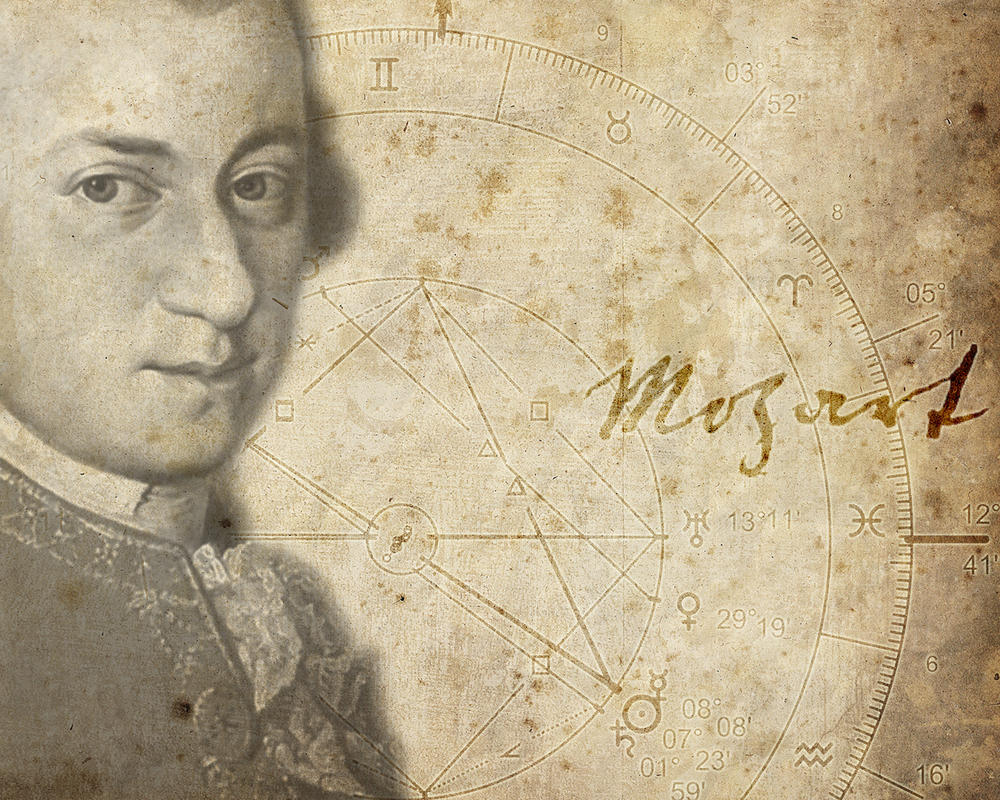 |
| Mozart, Natal Chart and Signature - my 2009 collage |
Serbia of the 1990s was not really the best place to grow up in, but it wasn't the worst either. Once the war in the neighbouring lands was over and shortages of oil, coffee, sugar and flour ended, it was almost bearable. In hindsight, those days now seem rather adventurous, I even tend to think of the 1990s as a prestigious school of life - it surely taught anyone with the eyes for the metaphysical that nothing lasts forever, that there's nothing really to be sure of in terms of social structures and values and that nothing is really impossible, on a more positive note as well as on the other one.
I grew up in Kruševac, a cosy town in Central Serbia, never too big to become unbearable and never too small to become suffocating, just one of those small centres of small administrative units that never really grow up and never lose nor gain anything to their charm, provided that they have any. The town quietly savoured its share of the Yugoslavian moral, ethical, cultural, financial and any other downfall you may think of, and there was me, one of the boys with hope that there has to be something better in this world, albeit without any clear idea what better was or should be. Under such circumstances, meeting Mozart was the last thing one might expect to happen, but it did - truly anything was possible back in those days.
It was just another dull day in my école primaire, a solid, tremendously depressing building, with Spartan classrooms freshly painted in three generous shades of grey. I believe I was 12 or 13, and it was a usually hopeless class of musical culture held by a lovely lady who tried so hard to share her love for music with the kids who couldn't care less for anything older than themselves and who were heavily swayed by the then-popular muzak and successfully pretended the teacher was not there at all.
I remember the day clearly because it was one of the rare occasions that I actually learned anything valuable in school. The teacher was talking about Mozart's last days with great fervour (although with more knowledge of the legend than the actual facts, as my further studies of Mozart would later show) and the tale of the mysterious disguised figure commissioning a funeral mass, Mozart's early death and the poor funeral deeply disturbed me, so I paid a closer attention to her words.
"And now, I will play you the Requiem!" - she said so solemnly that it was clear that she didn't give a damn that nobody was actually listening to her. That's the kind of attitude I'd learn to appreciate in the years to come, but that's another story.
The music began, cracking from the tape of awful quality, but it didn't matter. It didn't matter that the rest of the classroom shouted and laughed their asses off so the music was barely audible. Nothing really stopped the opening bars of Mozart's Requiem taking me to the places I never knew existed and introducing me to the level of reality I never dreamed of. I barely understood anything, I didn't even know what the Requiem was, but that didn't matter, too. I was being touched by the music and the real things were only beginning to take shape, the beauty was only beginning to reach my senses. It was my epiphany, the dawn of my Weltanschauung had broken - where I was and what I knew at the time became largely irrelevant.
I obtained a pirated copy of Philips' 2 CD set 'Mozart - The Great Choral Works' (no official releases were available on my shores back in the day) a few days later, and my bond with Mozart's music was established. I listened to the music closely for hours and hours and began to see life in Mozart's seemingly austere funeral mass. It was appropriately solemn, but the pure fire, a real river of hot molten verve was running underneath that dark and sad piece, from the ethereal voices of Introitus to the infernal strings of Confutatis and the immaculate beauty of Lacrimosa, that music was not mourning death, but celebrating life in each and every bar.
Sir Colin Davis' recordings of Mozart's works (choral works and the German operas) are possibly the best versions ever committed to tape. No version of Mozart's Requiem I have heard since was as convincing and powerful as Sir Colin Davis' 1967 recording with John Alldis Choir and BBC Symphony Orchestra
I didn't know a word of Latin at the time, knew very little about Mozart, but I still believe that I learned a valuable lesson back then, that Mozart's music showed me the farthest point of what a human being can grasp about life, death, time and everything else in between. It showed me a glimpse of mystery and a real secret can never be put in words.
Ironically, but appropriately enough, my friendship with Mozart began with his last, unfinished work. It took years until I fully introduced myself to that wonderful body of work Mozart left in his bequest to the world - to anyone willing to listen, actually. Mozart's music has been more than a collection of lovely sequenced sounds to me. It has been a valuable resource of inspiration, spiritual retreat, the promise that there is still some good out there in the dark days and a powerful refreshing force of the bright ones. The music has been there to accommodate any spiritual upheaval I could have been facing and to remind me how weak and how strong, how small and how grand I may be. Mozart has been the friend who'd always smile somewhere from the depths of the Universe and tell me that it's going to be all right, even at the times when it seemed that nothing will be all right. God knows Mozart never lied and Mozart was never wrong.
Because everything is there, written by his hand. Mozart was possibly the most human artist to have lived as no art has ever been so divine and so fragile and human at the same time. It reflects the wonderful irony of human perfection and divinity and frailty and cruelty better than anything else, and it is always so poignantly optimistic, it always harbours love, light, faith and goodness underneath the tapestry of minor chords and austerity.
There are many examples, but Pamina's tentamen suicidii from 'The Magic Flute' is possibly the most beautiful and the truest depiction of human nature, our addiction to despair and inability to fathom the wider image.
Es siegte die Stärke
Und krönet zum Lohn
Die Schönheit und Weisheit
Mit ewiger Kron'.


No comments:
Post a Comment